Go Red for Women - a mini-recap of the International Stroke Conference 2026
Twenty-one years ago I experienced a massive hemorrhagic stroke. This kind of stroke occurs when blood leaks onto the brain because of a burst artery or vessel or something else.
In my case, it was a ruptured artereovenus malformation. An AVM is a snarl of blood vessels and arteries that are incorrectly connected to veins. In the images below, the AVM is the mass in the middle.
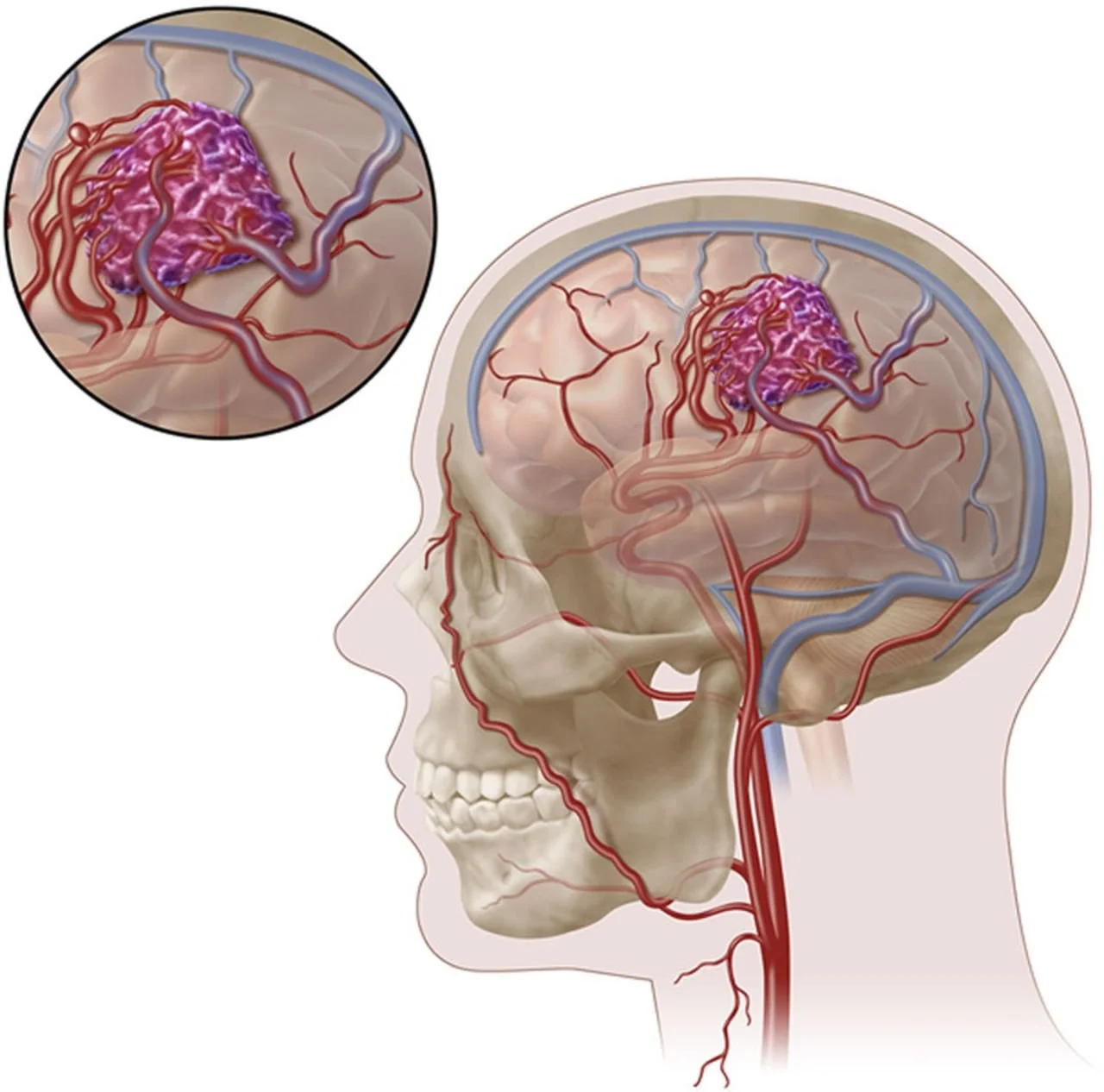
AVM - from American Stroke Association: https://www.ahajournals.org/doi/10.1161/str.0000000000000134
Two days after my 22nd birthday (right after Christmas), the unknown knot of improperly developed tissues burst in my head. It caused an intense headache, nausea, a loss of depth perception and a loss of reasoning skills. My dad knew I was having a stroke, so he got me to the hospital near my childhood home in Nebraska. From there I was life-flighted to Casper, Wyoming, for brain surgery. I spent a month in the hospital relearning to walk, type, think, and function again. It took my four years to feel like I had mostly recovered emotionally.
Two years into my healing journey I began to volunteer at was then called the Rehabilitation Institute of Chicago. Today the RIC is called the Shirley Ryan Ability Lab, and they are leaders in caring for people with disabilities.
Since then, I ’ve written about my stroke, talked about stroke in young people to anyone who will listen, and have advocated for people who have traumatic brain injury-related seizures— because I, too, developed seizures a year after the stroke. Eventually, I linked the seizures to stimulants, specifically coffee, and stopped consuming caffeine. The seizures have stayed away.
For the past couple of years I’ve been a volunteer with the American Heart Association- South Dakota, and when they asked me if I would be willing to go to the International Stroke Conference and share my story as a survivor so that researchers and doctors could learn from me and others, I jumped at the chance.
Stroke is not something typically associated with young people, and at 22, I was super young for this experience. During the past week I was able to connect with roughly 50 other stroke survivors and care givers, and in the group there were at least three of us in the group who had experienced stroke in our 20s. Stroke is a leading cause of disability in the US, and the 4th cause of death among Americans annually.
It’s everyone’s business to learn the signs and symptoms, ways to prevent it and how to help someone if they’re experiencing a stroke.
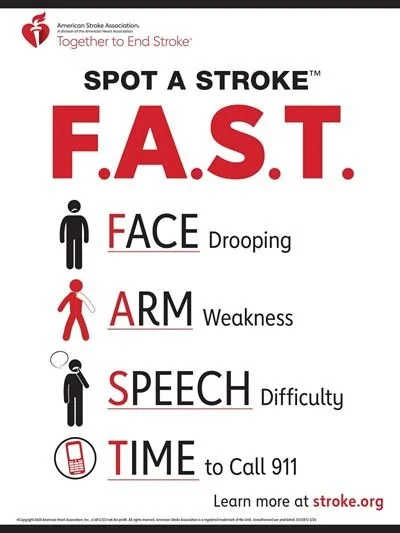
The FAST acronym is a way to remember how to spot a stroke - https://www.stroke.org/en/help-and-support/resource-library/fast-materials/fast-poster-2020
Remember the signature calling cards of droopy face, weak arm or leg, and headache, nausea or impaired vision because you can save some one. But also because it could be you some day.
I learned so much at the Conference: about rehab and developments with technology, including gamification of therapies; about how AI is helping doctors get clearer images from mobile MRI units (which could be real game changers in rural areas like the one where I had my stroke and had no access to an MRI or CT can); about how stroke survivors are more likely to develop dementia as they age, and that blood leaking into the brain is likely a factor in that. Research on this has been ongoing for 15 years (!!) and continues. The researcher told me that by the time I have to worry about this, maybe there will be more answers for me.
This was somewhat comforting, but I believe the time for any one to worry about their health is now. We only have this one body, and although we might get a second shot (or even a third in some cases) at life after a stroke or other ccardiovascular event, one way to prevent stroke and heart disease is to make good choices today.
if you know me you know that I had to change my lifestyle after my stroke. Not because anything I was doing caused the stroke—the AVM was congenital—but because my poor brain couldn’t handle the boozin’ and late nights I put my previously undamaged brain through. Today I’m a two-drink drinker, or maybe three if I’m feeling rowdy, and I asked this researcher if she thought a couple of drinks now and then was going to speed up my already sped up brain decline. She said she didn’t think a couple drinks here and there was any more impactful than smog or life in general, and life my neurologist so many years ago, she said that anything in moderation is better than binging.
It feels a little odd ending my post about this experience by talking about alcohol, but there’s always going to be a part of me that’s stuck back at age 22, when one life stopped and another started, and part of that life at 22, as for many other peers, involved bars and beers. It also involved a lot of caffeine, and I eventually gave that up all the way, because I had to.
So I guess my point here is that I’m continually inspired by the things I learn about stroke and recovery, and others who have lived through the bad and good of that experience. If my story inspires you in any way to be healthier, that’s a win!